In Conversation with Chris Wallace: Reflections from OTC 2026
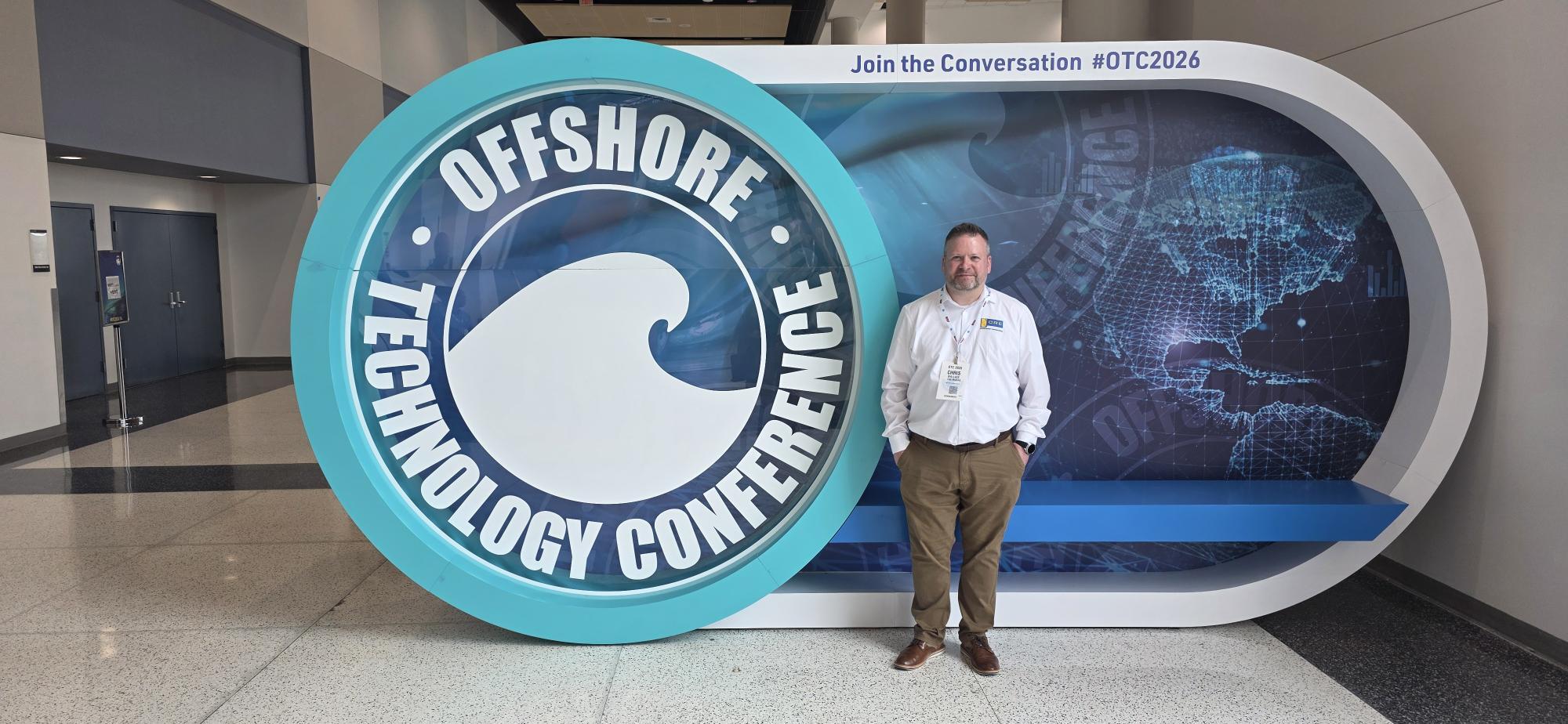
OTC remains one of the most influential events in the offshore energy calendar, bringing together operators, OEMs, integrators, technology developers, and supply chain specialists from across the global subsea industry. Earlier this month, CRE Marine’s Business Development Manager, Chris Wallace, attended OTC 2026 in Houston to meet with customers and industry partners, discuss emerging technologies, and explore the changing priorities shaping offshore operations.
Having joined CRE Marine late last year, OTC provided Chris with an opportunity to gain further insight into the evolving offshore and subsea landscape while representing CRE Marine’s growing capabilities across subsea connectivity, fibre optics, micro connectors, and harsh-environment solutions. In this Q&A, Chris shares his reflections from the event, key industry conversations, and his thoughts on where the offshore energy market is heading; from data-driven systems and AUV development through to project investment, collaboration, and the increasing importance of reliable subsea connectivity.
1.OTC is often described as one of the most important events in offshore energy — what makes it such a valuable conference for CRE Marine?
OTC is a great event for us because it brings together such a wide variety of customers from across the Americas in one place. It gives us the opportunity to explore new applications, discuss upcoming projects, and look at where CRE Marine can support operators, OEMs, and contractors within the region.
From a business development perspective, having so many oil and gas companies, suppliers, and technology partners all in the same place at the same time really helps maximise the value of the event. You can have a huge number of conversations across different parts of the industry, but you also start to see the crossovers between projects, inquiries, and potential collaborations.
What’s especially valuable is the ability to connect not just with end users, but also with other suppliers and partners to help pull together a complete project solution. Those conversations often lead to stronger integration between technologies and a more joined-up approach for the end client, which is always beneficial from our point of view.
2. This year’s OTC theme focused on ‘Steering Offshore Energy Innovation into the Future’. How visible was that theme across the event?
The show itself felt a lot smaller and quieter than it has in previous years, and many of the exhibitors were focused more on the nuts-and-bolts side of the industry rather than showcasing major innovation themes directly on the exhibition floor.
The conference sessions themselves probably aligned more closely with the theme of “Steering Offshore Energy Innovation into the Future,” but there seemed to be less of that visible within the exhibition itself. In reality, many of the more forward-looking conversations happened around the conference rather than directly on the stands - in breakout areas, informal meetings, and the various networking events taking place throughout the week.
There was definitely more discussion around where the market and the wider industry are heading, what future projects might look like, and how the sector is evolving. From our perspective within the supply chain, I wouldn’t say that innovation theme was necessarily front and centre for us specifically, although at operator level there were probably more strategic conversations taking place.
Where we sit in the supply chain, those discussions tend to filter down in a slightly different way. The conversations were more focused on what the next major projects are, where investment is heading, and what the future priorities will be across offshore energy. So while the theme may not have been heavily reflected across the exhibition itself, the conversations around future direction and industry focus were certainly happening.
3. Did you notice any major shifts in priorities across the offshore energy sector this year?
I think, generally, there’s a lot of concern across the energy industry at the moment, particularly within oil and gas. A lot of that is being driven by the current oil price and the wider geopolitical situation, and those conversations were just as present in the Americas as they are elsewhere in the world.
There’s a feeling that while higher oil prices should normally encourage investment, there still seems to be a slight reluctance around major capital expenditure at the moment. Companies appear to be holding back on large CAPEX decisions because of the uncertainty and instability surrounding the oil price, and I think that’s delaying quite a few projects.
From past experience, particularly in the UK and broader European markets, that kind of hesitancy around major investment has existed for a number of years. Historically, the US market has been less affected by that mindset — if something needed to be done, companies would generally move forward with it. But this year there seemed to be more caution around where companies are investing, what projects they are progressing, and what direction they are taking.
By contrast, Brazil feels like a much more buoyant market at the moment. There’s clearly more movement, more activity, and more investment happening there. We’re seeing that not only through conversations in the US, but also from the UK side, where many companies are currently focusing more heavily on Brazil than almost anywhere else in the offshore sector.
4. As offshore systems become increasingly data-driven, what connectivity challenges are customers most focused on today?
It’s definitely high up on the list of requirements for customers across various markets, not just the energy sector.
There’s a much bigger focus now on more data transmission, real-time monitoring, and faster processing of information. Having instant access to data seems to be one of the key drivers at the moment. Faster Ethernet speeds have always been at the forefront of customer requirements generally, with companies continually trying to push that as far as they can. They’re always looking at how they can handle more data and improve transmission speeds wherever possible.
At the same time, I’m definitely seeing more of a genuine shift towards fibre optic technology because it allows for greater bandwidth, higher speeds, and more instantaneous connections. The fibre optic side of things is definitely becoming more driven by customer demand, which is one of the reasons we developed a new fibre optic connector.
That’s really where we’re seeing a lot of the movement in the market at the moment in terms of increasing data demand and the need for faster, more reliable offshore connectivity.
5. Why is reliable subsea connectivity becoming more critical across offshore operations?
Reliable subsea connectivity is becoming more critical because reliability equals a better return for operators and for the companies delivering the projects. If systems are reliable, there’s less requirement for IRM activity, which ultimately saves money on operations and reduces the need for intervention offshore.
There’s definitely a drive towards longer-duration programs as well, with people wanting equipment and systems left in the water for much longer periods of time. Having that reliability, and knowing that reliability is there, gives customers peace of mind that the system will continue to perform over the long term.
I think all too often connectors and cables are still left until the last minute. They’re the important part that joins everything together, but because there’s usually a major system here and another major system there, the connectivity side tends to come last while people focus on the bigger items first.
That’s why earlier conversations are so important, because they allow us to properly understand the scope and provide the right products for the project rather than trying to solve it at the last minute.
6. Were there particular applications or project types where CRE’s solutions generated strong interest?
I think a key area for CRE Marine at the moment is within AUV and ROV applications. These projects are increasingly focused on longer-duration deployments and deeper-water operations, particularly on the AUV side where customers are trying to maximise the payload capability within the vehicle itself.
A big part of that is fitting in as many sensors and pieces of equipment as possible while still maintaining reliable connectivity. That’s where products like our micro connector ranges are generating strong interest, because they help reduce space requirements while still keeping everything operating effectively. That’s definitely been an area where we’ve seen a significant increase in interest.
Then, as we touched on earlier, there’s also the growing demand around more data-driven applications. Things like 3D imaging, photogrammetry, 4K video, real-time monitoring, and the need for instantaneous access to data are becoming much bigger drivers across offshore systems.
We’re seeing that demand not only on standard connector solutions from a data transmission perspective, but increasingly on the fibre optic side as well, where customers need higher bandwidth, faster speeds, and more reliable real-time data capability.
7. What types of discussions were you having with visitors and industry contacts at OTC?
The most common discussion - which probably won’t surprise anybody - was around the oil price. That definitely came up regularly throughout the event and was a major talking point across the industry.
Alongside that, there were a lot of conversations focused on new technologies and what companies are developing moving forward. We discussed things like 3D imaging, photogrammetry, AUV applications, resident ROVs, and the increasing demand for more data-driven offshore systems.
There were also plenty of conversations around the requirement for more data, higher transmission speeds, and the move towards smaller connector solutions, particularly where customers are trying to maximise space and payload capabilities within subsea systems and vehicles.
I think the key point, though, is that while these conversations were happening at OTC, they’re not unique to oil and gas or the offshore energy sector. We’re seeing the same discussions happening across multiple markets including defence, ocean science, and other subsea technology sectors. The use of AUVs, autonomous systems, newer imaging technologies, and real-time data capabilities are becoming central conversation points across the industry as a whole at the moment.
"Reliable subsea connectivity is becoming more critical because reliability equals a better return for operators and for the companies delivering the projects. If systems are reliable, there’s less requirement for IRM activity, which ultimately saves money on operations and reduces the need for intervention offshore."
- Chris Wallace, Business Development Manager
8. How does CRE Marine differentiate itself in a highly technical and reliability-focused market?
I think probably the key thing for us is flexibility, and being able to meet specific customer requirements. Whether that’s a different pin configuration, material selection, how quickly they need something, or even a completely new concept they want to work on, CRE Marine has the flexibility to meet those requirements and support customers with what they need.
At the same time, we’ve also got the knowledge and experience that comes from almost 25 years in the industry, so we can back that up with actual data and the legacy of products already out there proving that the connectors are reliable in real-world subsea applications.
I think as well, just the vast breadth of markets, industries, and applications we’ve worked across means we can meet almost any requirement that comes our way.
9. Which CRE capabilities or product areas resonated most strongly with attendees this year?
I think fibre optics again was a major area of interest, along with smaller connectors and the new product developments people are working on across the industry.
But one of the key things that came up time and time again was probably turnaround time for connectors — how quickly people can get hold of connectors, full cable assemblies, and everything else they need to get systems operational.
That definitely seems to be a big driver for a lot of customers at the moment. They need things yesterday, particularly in areas like the survey world where they often don’t know exactly what’s happening until the very last minute. Once a project moves, they need to mobilise quickly, and that’s where they rely on support from CRE Marine to provide very fast turnaround times for connectors, cable assemblies, and complete connectivity solutions.
10. OTC brings together operators, OEMs, integrators, and technology specialists from around the world. What does that level of collaboration mean for the future of offshore energy?
Having that level of collaboration and knowledge sharing between everybody is absolutely paramount, and probably the most important part is that the earlier it happens, the better.
If you’ve got operators, companies developing new technologies, integrators, and OEMs all working together from the beginning of a project, it means you can properly look at the requirements for the technology, understand the timelines for development, and establish what people actually need from the outset.
It also allows everyone to identify and overcome potential hurdles as early as possible, rather than discovering problems later on and delaying projects moving forward.
11. What do you think the offshore industry is getting right at the moment — and where are the biggest challenges still ahead?
There are definitely more early conversations happening, as I mentioned before. We’re seeing more engagement earlier in projects, which is really important.
At the same time, we still need better insight into what’s happening on some of the major projects and how that information filters down from the operators right the way through to the lower levels of the supply chain.
I think the adoption of new technologies is getting better as well. It could still improve, but there’s definitely movement there. The industry is still very much driven by a risk-versus-reward mindset, particularly at the higher levels where companies tend to be very risk averse — we all know that. But there are technologies out there that really could help advance things in a lot of ways, so taking a few more chances now and again would probably benefit the industry overall.
I think one of the other challenges is that companies — and this is true right across the industry, from operators down through the supply chain — don’t always share the problems they’re facing. People tend to keep those issues to themselves, whereas if the problem was shared more openly, somebody has probably already got a solution for it.
And I say that from experience across every company I’ve worked with. It’s rarely just a connector problem or a single product issue. Sometimes the bigger challenge has already been solved elsewhere, and because we’ve worked across different industries and applications, we might know somebody who has dealt with that exact issue before. That knowledge is often cross-transferable.
I think looking outside of our own little bubble helps as well. The defence sector is starting to do that much more now - looking outside of traditional defence suppliers for solutions - and that’s created massive growth opportunities for companies like CRE.
"I think one of the other challenges is that companies — and this is true right across the industry, from operators down through the supply chain — don’t always share the problems they’re facing. People tend to keep those issues to themselves, whereas if the problem was shared more openly, somebody has probably already got a solution for it."
- Chris Wallace, Business Development Manager
12. What are the biggest opportunities you see emerging across offshore and subsea technology over the next few years?
I think the key opportunities for CRE Marine over the next few years are definitely around smaller and micro connectors, particularly for AUV and ROV applications where customers are trying to maximise payload space.
There’s a growing requirement for smaller connectors and more novel mounting arrangements that allow operators to fit bigger payloads, more sensors, and more equipment onto AUVs and ROVs while still maintaining reliable connectivity in harsh subsea environments.
Then, as we’ve touched on already, there’s also the continued drive towards more data. More bandwidth, more real-time monitoring, more instantaneous access to information, and that naturally drives further demand for fibre optic solutions as well.
On some of these newer platforms, we’re also seeing increasing requirements around propulsion systems, particularly the need for much higher-power and higher-current connectors to support evolving vehicle and subsea system designs.
Another major opportunity is around the speed and reliability of supply. The offshore industry can be very reactive depending on oil price movements, project timelines, or operational problems, so being able to respond quickly and supply what customers need in short timeframes is becoming increasingly important.
That’s definitely a massive area for both the industry as a whole and for CRE Marine specifically. Being able to adapt quickly, support customers, and meet very short lead times is something we see as a real strength moving forward.
13. What key message would you take away from OTC 2026?
I think the key message I’d take away from OTC 2026 is that the conversations around and about the exhibition are just as important — if not more important — than the conversations happening during the conference itself.
I think everybody in a business development role probably already knows that, but it was definitely reinforced again this year. The discussions you have outside the conference sessions, whether that’s in breakout areas, networking events, or even just walking the exhibition floor, are often where the most valuable opportunities come from.
And I think the other big takeaway is to just be open to any conversation, because you never know where it might lead. I’ve had that at previous conferences where you have a very quick two-minute conversation with somebody, and it ends up leading to something much bigger further down the line.
-----
Click to explore CRE Marine’s full range of products and services, or to discuss how we can support your next project with bespoke subsea engineering solutions, get in touch with the team today.
Follow CRE Marine on LinkedIn to stay up to date with the latest developments in subsea connectivity, technology, new product innovations, and industry insights.
-----
Click to explore CRE Marine’s full range of products and services, or to discuss how we can support your next project with bespoke subsea engineering solutions, get in touch with the team today.
Follow CRE Marine on LinkedIn to stay up to date with the latest developments in subsea connectivity, technology, new product innovations, and industry insights.